Modern and contemporary Korean visual art has continually evolved through such a wide range of material experiments and responses to changing times that it is difficult to define within a single aesthetic framework. Distinctive sensibilities shaped by different periods have come together to create the rich visual culture seen today.
Perspectives on identity and social change also differ from one generation to another, while methods of expression continue to expand beyond conventional boundaries. Artists are transforming traditional materials such as hanji paper and lacquer in contemporary ways, while others combine digital media organically with established artistic techniques.
The individuality of artists who interpret the world through photography and sculptural form is particularly striking. Lee Jung’s photographs, which place neon text against silent natural landscapes, capture the emotional distance between language and surroundings with a powerful sense of resonance. Seung Yul Oh‘s sculptures and installations awaken spatial awareness through monumental scale and playful forms, while Kang Hong-Goo’s landscape photography quietly documents rapidly redeveloped areas and places disappearing from the urban environment.
The Diverse Landscape of Contemporary Korean Art
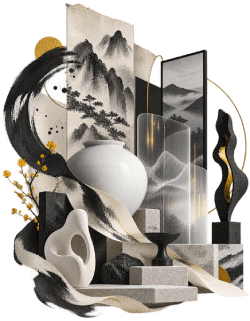
The days when Korean art could be explained mainly through the restrained aesthetics of Dansaekhwa or traditional white porcelain are long gone. Today’s creative scene is far too individual and multidimensional to be grouped under a single standardized style. Layers created through the intense encounter between Western modernism and local cultural sensibilities have contributed to the complex visual culture that exists today.
- Coexistence of Diversity: Practices range from traditional ink-brush techniques to advanced interactive installations.
- Open Discourse: Rather than one dominant artistic movement controlling the field, fragmented and highly diverse voices occupy the center of contemporary practice.
Generational Perspectives and Changing Identities
Senior artists who personally experienced major historical events such as liberation, the Korean War, and the democratization movement often focused on expressing collective memory and a sense of responsibility toward their times. Younger contemporary creators who grew up in digital environments, by contrast, are more likely to examine highly personal experiences, gender, everyday life, and small-scale anxieties rather than broad narratives of nation or ethnicity.
Older generations frequently engaged with the scars of history, the reality of division, and the lives of ordinary people through weightier narratives. Younger artists often approach web culture, borderless sensibilities, and fluid identities with a lighter but equally sharp perspective.
Sculptural Experiments That Break Down the Boundaries of Media
The physical rectangular frame of the canvas can no longer contain the imagination of contemporary artists. It has become increasingly common to build up layers of paint until they develop a sculptural texture or to bring flat images directly into three-dimensional space, allowing viewers to walk through and experience the work themselves.
Seung Yul Oh’s large inflatable installations provide a representative example. Their cartoon-like curves and strangely enlarged forms, sometimes resembling oversized strands of noodles, can quickly transform the solemn atmosphere of a museum into a playful environment. The tactile experience of moving around, encountering, and sometimes touching these monumental forms expands the conventional boundaries of contemporary sculpture.
- Transformation of Objects: Familiar everyday items are enlarged to unusual proportions, creating spatial tension.
- Reconsidering Materiality: Traditional materials such as lacquer and hanji are boldly combined with steel frames, synthetic resins, and other contemporary materials.
Recording the City and the Course of Everyday Life Through the Lens
Urban landscapes that are constantly demolished and rebuilt after decades of rapid, compressed development have become some of the most intense subjects of observation for visual artists working with photography.
Kang Hong-Goo photographs disappearing hillside neighborhoods and demolition sites in redevelopment areas such as Seoul’s Eunpyeong New Town, often beginning with black-and-white images and then applying rough layers of acrylic paint over them. Positioned between documentary photography and painting, his work quietly testifies to the loneliness of people who have lost familiar places and to the disruptive force of urban redevelopment.
Lee Jung takes a very different approach. She physically installs illuminated neon text in empty snow-covered landscapes or on deserted beaches and photographs the resulting scenes. When familiar romantic expressions such as “I Love You With All My Heart” glow through cold mist and darkness, viewers are confronted with a sense of modern loneliness and emotional emptiness hidden beneath the brightness of contemporary urban life.
- Urban Archiving: Remnants of redevelopment areas are collected, photographed, and painted over to document the disappearance of a sense of place.
- Visualizing Emotion: The contrast between natural landscapes and artificial light expresses both loneliness and the limitations of language.
The Fusion of Tradition and Technology
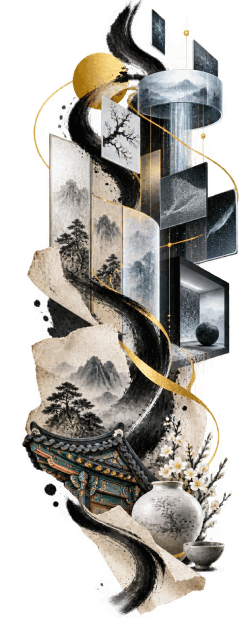
Korean media art is not simply about placing the latest technology inside exhibition spaces. Artists combine the movement of traditional calligraphic brushstrokes or the colors of dancheong decorative painting with projection mapping, while others reconstruct traditional narratives within virtual reality. These practices carefully connect the warmth of analogue traditions with the precision of digital technology. Data-driven systems can also reinterpret the visual language of traditional landscape painting in entirely new ways.
Interactive sensors that respond to viewers’ movements in real time can create vivid multisensory experiences and transform audiences from passive observers into active participants.
Expansion onto the Global Stage and the Contemporary Art Market
Korean artists have established an increasingly visible presence at major international biennales and global art fairs. Large-scale art fairs held regularly in Seoul have also attracted substantial transactions and growing attention from the international art world.
Part of this expansion comes from an approach that does not rely solely on presenting something as uniquely “Korean.” Instead, many artists reinterpret Korea’s experience of rapid social and economic transformation through themes that can connect with broader human experiences and international audiences.
Building Global Networks: Korean artists increasingly participate in curated exhibitions at major overseas museums and work with international galleries, strengthening connections across the global art scene.
A More Active Art Market: Major works valued from tens of millions to hundreds of millions of won continue to attract interest from international collectors.
A Future Defined by the Freedom Not to Be Defined
Contemporary Korean artists are no longer closely tied to the rigid question of what “Korean art” is supposed to mean. Their willingness to experiment freely with diverse media and express personal, sometimes deeply private experiences has itself become one of the defining strengths of Korean visual art today.
- Flexible Approaches: Artists move continuously between different media without being confined by a single movement, style, or national boundary.
- A Sustainable Future: As layered perspectives and material experimentation continue to intersect, the possibilities for Korean visual art are likely to expand even further.