Whenever we visit an exhibition, it is natural to wonder, “What process did these works go through before arriving in front of us?” Contemporary Korean art has gained global attention and developed such dynamic energy today because a strong ecosystem has long been working behind the scenes to maintain a delicate balance.
Public museums that protect cultural value, commercial galleries that introduce artists at the forefront of the market, and alternative spaces that encourage unconventional experimentation all interact to enrich Korean art. Here, we will take a closer look at how these three pillars work together and connect artists, institutions, and audiences.
1. Three Perspectives Supporting Korea’s Art Ecosystem
Every exhibition space has its own purpose, pace, and priorities. A healthy artistic ecosystem would be difficult to sustain if any one of these elements were missing.
●Public museums that research, preserve, and build the art-historical canon
- Public institutions such as the National Museum of Modern and Contemporary Art and the Seoul Museum of Art focus less on passing trends and more on works and ideas considered worthy of long-term historical documentation.
- They collect and permanently preserve national cultural assets while helping establish the broader narrative of art history through research.
- Regardless of commercial success, these institutions also examine artistic discussions that reflect the concerns of their time and provide the wider public with opportunities to experience culture.
●The competitive artist discovery and promotion system of contemporary commercial galleries
- Commercial galleries are among the institutions most sensitive to changes in both the market and the contemporary art scene.
- Rather than simply selling artworks, they identify promising emerging artists who may not yet be widely known and provide significant support for their development.
- Galleries such as ONE AND J. Gallery, known for its distinctive perspective within Korea’s contemporary art scene, have paid close attention to experimentation among younger artists. By helping them reach major international biennales and art fairs, these galleries have contributed to the broader foundations of K-art.
●Alternative spaces driving unconventional discourse and experimental creation outside established institutions
- Alternative spaces such as Alternative Space LOOP and Project Space Sarubia, which began emerging independently in the late 1990s, have supported raw forms of experimentation that commercial galleries and major museums could not always accommodate.
- By asking provocative questions such as “Can this also be art?”, they provide room for installation, performance, interdisciplinary art, and other practices that are less constrained by commercial logic or visitor numbers.
- Young artists who develop their practices in these experimental environments often later move into museums and major galleries, continuously bringing new ideas and perspectives into the wider art world.
2. Exhibition Formats and the Stories Curators Build Within Space
When entering an exhibition, it quickly becomes clear that very little has been placed by accident. From the arrangement of works on the walls and the intensity of the lighting to the short text positioned beside an artwork, every detail can contribute to the visitor’s experience.
The Importance of Solo Exhibitions in Presenting an Artist’s Worldview
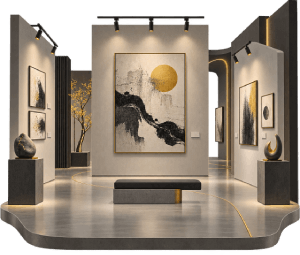
For an artist, a solo exhibition can represent a major turning point and an important professional challenge. Rather than presenting only a handful of works within a larger group setting, the artist must fill an entire space with their own visual language, rhythm, and ideas. It becomes an opportunity to evaluate, in one place, how themes developed over several years have evolved and how successfully the artist has translated those ideas into form. For that reason, solo exhibitions often attract considerable attention from critics, institutions, collectors, and the wider art community.
Curated Group Exhibitions Connecting Artists Through a Shared Spirit of the Times
Group exhibitions, by contrast, move beyond the boundaries of individual artistic practices and raise broader questions about contemporary society.
- Artists working with different media and techniques may be brought together around a shared theme, such as the climate crisis, digital transformation, or urban alienation.
- As different artworks encounter one another within the same exhibition, unexpected conversations can emerge, giving audiences a broader and more multidimensional perspective on the period in which they live.
Curators Who Select Works and Construct Spatial Narratives
A curator does much more than arrange artworks inside an exhibition hall. Curators identify ideas with wider historical or contemporary significance from among countless artistic practices and build a coherent narrative by considering everything from visitor movement to sightlines and the relationship between individual works. In this sense, the curator acts as a director of space. Through thoughtful selection and presentation, audiences can encounter artworks in ways they may not otherwise have considered and develop deeper emotional and intellectual connections with them.
3. The Geography of Art Spaces and the Expanding Art Scene
Korea’s art spaces may have developed strongly through the streets and neighbourhoods of Seoul, but today the map continues to expand as contemporary art increasingly interacts with distinctive local cultures across the country.
How Seoul’s Exhibition Scene Developed Across Different Neighbourhoods
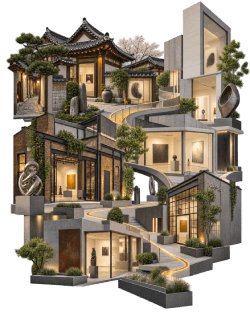
Seoul’s gallery districts have continuously shifted and expanded alongside social and cultural change.
- Insadong and Samcheong-dong: These neighbourhoods have long served as important foundations for the city’s art scene, preserving connections with traditional culture as well as the emergence of modern and contemporary Korean art.
- Gangnam: As Seoul experienced rapid economic growth, major commercial galleries established themselves in the area, helping transform it into an important centre of the Korean art market.
- Hannam-dong and Seongsu-dong: More recently, contemporary galleries with younger and more trend-conscious identities have gathered in these districts, reflecting the interests of a new generation of collectors and creators.
New Energy in Regional Cultural Spaces Beyond the Capital Area
The Korean art scene is by no means limited to Seoul. International events such as the Gwangju Biennale and Busan Biennale contribute to global artistic discussions, while residency programmes across the country provide valuable support for regional creators. At the same time, former factories, abandoned breweries, and old warehouses have been transformed into multidisciplinary cultural spaces. By combining the history of these locations with contemporary artistic practices, such venues offer both local residents and visitors new ways to experience art.
4. Global Connections and the Exhibition Records That Become Cultural Heritage
Contemporary Korean art now operates confidently within a much broader international landscape. At the same time, careful documentation ensures that this dynamic development can be studied and understood by future generations.
Connecting With Global Audiences Through International Art Fairs
Every autumn, Kiaf and Frieze Seoul bring art professionals, galleries, and collectors from around the world together in the Korean capital. Visitors can encounter everything from major masterpieces valued at hundreds of millions or even billions of won to energetic works by emerging artists. These fairs have become important meeting points where Korean galleries can introduce their artists directly to an international audience and build stronger connections with the global art market.
Exhibition Archives Documenting Changes in Artistic Practice
When an exhibition ends and the lights are switched off, the artworks may move elsewhere, but an important legacy remains behind: exhibition catalogues, programmes, and archival records.
- Slim pamphlets and exhibition catalogues quietly published by galleries in earlier decades can reveal how artists experimented with particular materials, techniques, and ideas at the time.
- They also preserve the aesthetic atmosphere of an era and the debates taking place among critics, making them valuable primary sources for reconstructing the development of contemporary Korean art.
- By transforming temporary exhibitions into documented historical events, archives allow later generations to study earlier creative practices and use them as a foundation for imagining new artistic possibilities.