Amid rapid economic growth, democratization, and globalization, contemporary Korean art has developed into a complex field that cannot be defined by a single style or movement. Seoul has emerged as one of Asia’s major centers for contemporary art, while the range of artistic expression has continued to expand from painting and sculpture to photography, installation, and digital media. Identity, urbanization, and everyday experience are recurring themes running throughout the scene, with Korean artists engaging with their time in distinct and individual ways.
How Did Contemporary Korean Art Develop Amid Rapid Social Change?
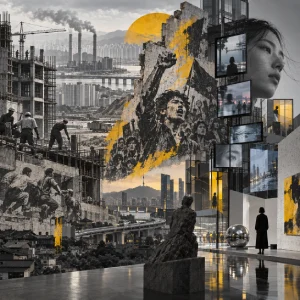
In the aftermath of the Korean War in the 1950s, Korean art faced the challenge of finding an entirely new visual language rather than simply rebuilding what had existed before. State-led industrialization shaped the 1960s and 1970s, cities expanded rapidly, rural communities weakened, and individual identity was often overshadowed by collective systems of production. This experience of compressed modernization became a powerful source of inspiration for artists.
During the intense democratization movements of the 1980s, Minjung art came to the forefront. Addressing labor, poverty, and state violence directly, the movement followed a very different path from the abstract language associated with Western modernism. Painting became a form of resistance, while murals and prints moved beyond galleries and into public spaces.
From the 1990s onward, globalization and the spread of consumer culture brought another major shift. The rapid growth of photography, video, and installation was not simply a matter of experimentation with new media. It also reflected attempts to capture rapidly changing urban life and fractures in collective memory. The focus gradually shifted from ideology toward sensory experience and the individual.
From Painting to Installation – Themes and Media in Korean Art Today
Contemporary Korean art is defined not only by the diversity of its media but also by the depth of the themes it explores. Painting, sculpture, photography, installation, and video each speak through different visual languages, yet several recurring questions connect them. These include urban life, the instability of memory, the body and identity, and the experience of everyday life in a rapidly changing society.
Painting and Sculpture – The Language of Memory and Material
Suki Seokyeong Kang combines weaving, sound, and space to translate historical memory into material form. In painting, there is also a noticeable tendency to prioritize sensation and atmosphere over clearly defined figurative imagery, allowing the noise, isolation, and emotional texture of urban life to enter the pictorial space.
Photography and Installation – Reconstructing Everyday Life
Noh Suntag’s photographic work sharply captures realities specific to Korea, including division and militarism. In installation art, the exhibition space itself often becomes part of the statement. Many works are designed around direct audience participation, allowing viewers to enter, move through, and physically experience the artwork rather than simply observe it from a distance.
Technology and Mixed Media – A Generation Erasing Boundaries
Younger generations of artists freely combine video, sound, and interactive technologies. The boundaries between genres matter less than the strength and complexity of the questions being explored. This is one of the main reasons contemporary Korean art cannot easily be grouped under a single recognizable style.
Why Has Seoul Become a Major Center for Contemporary Art?
Alongside rapid economic growth from the 1990s onward, Seoul significantly expanded its cultural infrastructure. The Seoul branch of the National Museum of Modern and Contemporary Art opened in Jongno-gu in 2013, helping establish a major art hub in the city center. At the same time, commercial galleries and alternative art spaces became increasingly concentrated in areas such as Samcheong-dong and Hannam-dong, creating distinct cultural districts.
The Role of Commercial Galleries and Independent Spaces
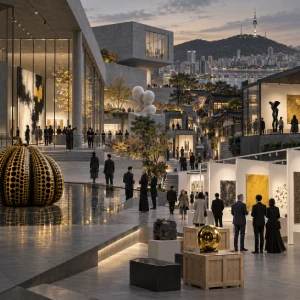
Commercial galleries have functioned as more than sales venues. They have played an important role in discovering artists and connecting them with collectors in Korea and abroad. One & J. Gallery, for example, was established with the aim of introducing Korean contemporary art and artists to domestic and international audiences. Its activities have included organizing solo exhibitions for emerging artists and participating in international art fairs. Independent art spaces have also continued to support experimental projects outside major institutions, helping maintain the diversity of Seoul’s art ecosystem.
Expansion onto the International Stage
The simultaneous presence of Kiaf Seoul and Frieze Seoul has played a significant role in strengthening Seoul’s position within the Asian art market. Korean artists have also continued to expand their presence at major international events and institutions, including the Venice Biennale and Art Basel. Seoul increasingly functions both as a starting point for international careers and as a place to which artists and galleries return.
The Strength of Contemporary Korean Art Lies in Its Diversity
Any attempt to define this art scene through a single aesthetic risks overlooking its essential character. The landscape has been shaped by generations that directly experienced social change after democratization, artists who developed within Seoul’s growing institutional infrastructure, and galleries such as One & J. Gallery that were established to introduce Korean contemporary art to international audiences.
What has emerged is not a single style but a collection of diverse voices. Painting and installation coexist with photography and technology-based media, while independent spaces and international art fairs both contribute to shaping artists’ careers. When approaching Korean artists, galleries, and exhibitions, one of the most useful perspectives is therefore to focus on change and diversity themselves. This plurality is one of the most defining and genuine characteristics of contemporary Korean art.